Cinema as escape from reality
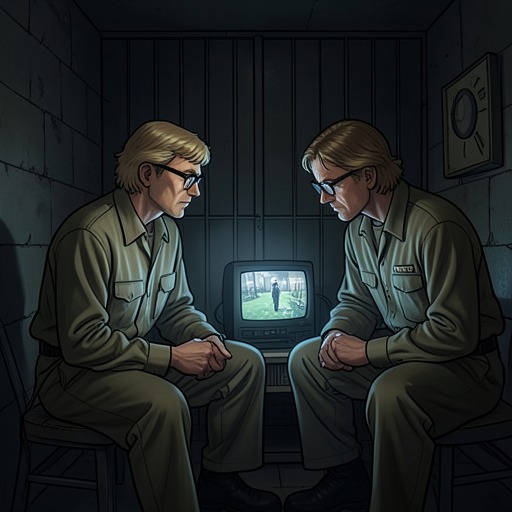
Kiss of the Spider WomanCinema as escape from reality is both a coping practice and a contested idea in the prison conversations between Molina and Valentin. For Molina, recounting films can make him forget the cell and its misery; for Valentin, the same turn away from present conditions risks becoming a habit that blocks thought and political understanding. Their nightly exchange makes film narration more than entertainment: it temporarily alters how the two men experience confinement, while revealing their different ideas of what it means to face reality.
The Cell and the Relief of Story
Molina explains that before Valentin brought the subject of his mother into their conversation, he had been feeling wonderful because he had forgotten the filthy cell while telling the film. When Valentin asks why he should break that illusion for both of them, Molina objects to the interruption itself. The exchange makes the relief concrete: the film has not changed their circumstances, but, for a time, it has redirected their attention so completely that the prison recedes from awareness.
Molina later states the purpose more directly. Locked in the cell, he is better off thinking about pleasant things so that he does not go mad. He imagines that prolonged despair could make him lose his reason, and invokes the possibility of becoming like Charlotte of Mexico; in a comic counter-image, he would rather become Christina of Sweden and end up a queen. The joke gives his escape a theatrical, self-inventing quality, but the need beneath it is serious: he is trying to manage the psychological pressure of incarceration by entering another world through narration.
The stories work in the time shared by the two prisoners, not only in Molina’s private imagination. Valentin had asked him to tell a film because he could not sleep, and Molina reminds him of that request when Valentin seems to be doing him a favor by listening. Valentin thanks him, then asks for more, even though he had initially treated the account as something of interest chiefly because it might serve as a document of propaganda. Their exchange thus makes film telling a practical form of company: it answers sleeplessness, occupies the night, and gives the prisoners a shared object of attention.
Making a Screen in Words
Molina’s recitations rebuild film through selected images, costume, lighting, movement, and sound. In one account, the action shifts from a remembered movie house in the Belgrano district of Buenos Aires to a lavish music hall in Paris, upholstered in dark velvet and edged with chrome balustrades. Chorus girls first appear in costumes made to resemble skirts of bananas; a turn and a crash of cymbals transform the image into blonde performers glittering with imitation jewels. The change is described as a visual reveal, not merely reported as a plot point.
The next entrance is staged through gradual visibility and light. A woman in a silver lamé gown emerges as a silhouette behind layers of tulle, becomes clearer as she steps forward, and descends through a staircase whose edges appear as flashes of lightning. A young German officer watches from a box. Molina’s minute attention to the reveal, the gown, the height of the stage, and the changing lights lets his listener picture a spectacle that neither man can see in the cell. In another film account, he establishes the setting with fishermen heading out before dawn, music drifting across the water, a brightly lit villa above a beach, and the last couples at the Mardi Gras of Veracruz. The narration repeatedly supplies cinema’s sights and sounds in language, making description itself the vehicle of escape.
That verbal reconstruction does not simply reproduce a screen. It selects, delays, and heightens: a light rises through mist, the performer’s outline sharpens, and the stairs are recognized only as she descends. Molina also pauses to clarify what strass is when Valentin asks, then is urged to stop explaining and continue the story. Their interruptions expose the making of the imagined film and keep the scene tethered to the two speakers’ present. The tale can transport them, but it remains an act of telling between cellmates.
Escape, Study, and the Political Present
Valentin challenges Molina’s reliance on pleasant stories. He argues that escape can become a vice, comparable to taking drugs, and that reality is not limited to the cell: reading and study can transcend confinement. His objection is not that the cell’s despair is unreal, but that exclusive retreat into agreeable fantasies can estrange a person in another way. The disagreement gives cinema as escape from reality its central ambiguity. Imagination can relieve immediate suffering, yet relief alone may also narrow attention to the conditions beyond the story.
Molina does not simply dismiss Valentin’s criticism. He asks how politics can be expected to improve the world, then returns to the film and its remaining scenes. Valentin, in turn, says that he is interested in it as propaganda and as a kind of document, but later acknowledges that Molina began telling it because Valentin could not sleep. Their exchange holds together two approaches to the same narration: Valentin wants to read the film as evidence about politics, while Molina values its beauty and its capacity to console. Neither function cancels the other, and the difference between them becomes part of what the film-telling allows them to discuss.
The act of narration also alters who is asking whom for something. Molina points out that Valentin had requested the story, but now Molina is the one who is awake and Valentin has drawn him into continuing. Listening is not passive: Valentin’s questions guide the pace and direct attention, while Molina’s insistence on telling the story sustains their conversation. Cinema therefore offers escape without removing the men from relation to each other; the shared account keeps returning them to the cellmates speaking in the dark.
Melodrama, Feeling, and the Limits of Consolation
The film set around the masked ball develops escape through a romantic plot marked by confinement and belated recognition. A singer, exhausted by the theater, has married a wealthy man who takes her around the world but eventually keeps her virtually imprisoned at home and refuses her request to perform again. A reporter destroys an article that would have implicated her, then refuses the money she offers him. Their attraction does not resolve the conflict: she is afraid to leave with him, and he storms out after she insists on making her own choice.
The separation is rendered through music and objects. The reporter composes a bolero in a bar, and later leaves its lyrics on a table during a confrontation with the magnate. When the magnate slaps the singer and departs, she finds the paper and presses it to her heart. She eventually leaves the wealthy man and returns to singing, but the reporter, ill and destitute, has gone missing. The magnate later finds her and gives her back her jewels; she sells them to pay for the reporter’s treatment, searches hospitals and jails, and finds him gravely ill in a hospital. He imagines a new life and a voyage with her, but his fever makes clear that his hopes are delirious. He dies as the imagined schooner carries them toward an unrealized future.
The ending refuses to make imaginative consolation equivalent to rescue. The singer leaves the money from her jewels with the hospital sisters and walks alone along the shore. The reporter’s songs continue in the voices of fishermen and young couples, so that something of the lovers’ shared story survives even though their life together does not. Molina’s account gives the film a musical afterlife, but its beauty intensifies rather than erases the loss. The story can provide a temporary world in which love finds its expression; it cannot undo the death that closes that world.
From Film Image to Shared Imagination
Across the conversations, the films’ elaborate surfaces—lamé, tulle, chrome, jewels, music, a lit villa—offer Molina materials with which to make the cell recede. Their abundance contrasts with confinement, but the narrated scenes also carry conflicts about power, choice, hunger, and loss. Valentin’s questions and objections keep those stories from remaining a private retreat, while his willingness to listen makes the retreat a shared experience.
Near the end, an imagined island scene returns to visual elements associated with the earlier film narration: a strong spotlight, a woman in a shining long gown and silver mask, and an image that cannot be fully explained. The scene is presented through Molina’s conversation and imagination rather than as a simple escape into a completed, reassuring story. This recurrence shows how filmic images persist beyond the particular plot being recounted, but also how uncertain their comfort can be. Cinema offers Molina and Valentin a passage away from the cell for a while; the conversation surrounding it keeps that passage connected to the realities, disagreements, and needs they cannot leave behind.